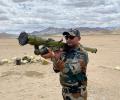
The new supplies of the Igla-S air defence missiles have been received by the Indian Army a couple of weeks ago and are being provided to the forward formations for taking care of the threat from enemy fighter aircraft, choppers and drones on the borders.

Announcing the launch of "Mission Sudarshan Chakra", Modi said it will be aimed at neutralising enemy threat and enhancing India's offensive capabilities.
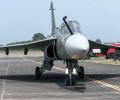
HAL executives said deliveries of the Tejas Mk1A to the IAF would begin within this year, but only after the successful completion of the weapons-firing trials currently underway.

'This policy is a vision to position Karnataka as the epicentre of India's space ambitions'

The weapon system is customised to operate in altitude above 4,500 metres and has latest upgrades including indigenously developed Radio Frequency seeker, as per the release.

India has approved proposals to procure weapons and military hardware worth Rs 79,000 crore, including Nag missiles, amphibious warfare ships, and electronic intelligence systems, to enhance the military's combat capabilities.
'There are only a few countries in the world that have deployed combat-ready laser systems.'
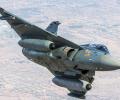
HAL's order book amounts to Rs 2.45 trillion by end of Q2FY26, implying a book-to-bill ratio of 32 times based on FY25 revenue.

According to an international media report, the jet crashed in the afternoon local time while flying a demonstration flight at the prestigious air show.
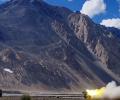
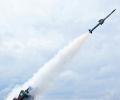
The successful validation will speed up induction and significantly bolster India's air defence posture in sensitive frontier zones.

The government on Wednesday approved a Rs 7,280 crore scheme to promote manufacturing of rare earth permanent magnets, a move which would help reduce India's dependence on China.
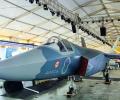
This is seen as the first concrete opportunity to break HAL's monopoly in combat aircraft manufacturing, potentially opening the door to a private-sector fighter jet producer.

It's a strategic approach in which the country's military and defence mechanisms evolve continuously in tandem with emerging threats. The new strategy anticipates events and prepares to counter those proactively.
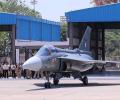
HAL has assured the IAF that 12 Mk1A aircraft will be delivered by the end of 2025-2026.
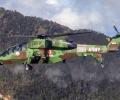
Of the 156 LCH, 90 would be for the Indian Army while 66 would be for the Indian Air Force.

'Our problem is not a budget deficit but a trust deficit. We need to trust our institutions and industries to innovate and lead. That is the way forward for India.'

India successfully test-fired nuclear-capable short range ballistic missiles Prithvi-II and Agni-I from an integrated test range off the Odisha coast, demonstrating its strategic deterrence capability. The test-firing of the missiles, conducted by the elite Strategic Forces Command, validated all operational and technical parameters.

'Currently, it takes between two and three years to formulate the request for proposal for procuring specific military equipment for the armed forces. It should not be this way.'
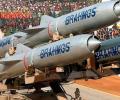
The Navy would be using the missiles for equipping its Veer-class warships while the Indian Air Force would be using them to equip its Russian-origin Su-30 MKI fighter jet fleet, the sources said.

INS Udaygiri and INS Himagiri marks the first occasion when two frontline surface combatants constructed at two different shipyards were commissioned simultaneously.
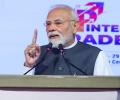
"This time, the country partner of the trade show is Russia. That means we are further strengthening a time-tested partnership through this trade show," the Prime Minister said.
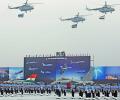
The Indian Air Force celebrated its 93rd anniversary with a ceremonial parade at the Hindan Air Force Station in Ghaziabad. The event honoured exceptional Air Warriors and showcased both heritage aircraft and modern assets like the Rafale, Su-30MKI, and Apache helicopters. Emphasising indigenous strength and readiness, Air Chief Marshal Amar Preet Singh hailed the IAF's growth from modest origins to a global force.

'Government officials use Gmail and ordinary phones without basic security consciousness.' 'Interoperability, especially in joint exercises with countries like the US, worries me.' 'It often means we open our systems to them, but they don't reciprocate.' 'They could have kill switches in their systems and might even be able to affect ours.'

A big question mark is on whether Shashi Tharoor, who had led the delegation to the US among other countries, will be picked as speaker by the Congress, as the seasoned Lok Sabha member's enthusiastic endorsement of the government's action following the terror attack has soured his ties with his party.
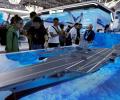
China has commissioned its third aircraft carrier, the Fujian, featuring advanced electromagnetic catapults, amidst rising tensions and military modernization efforts.

Air Chief Marshal AP Singh said the Indian Air Force's attacks during Operation Sindoor restored offensive air action. He highlighted the effective use of air power in shaping military outcomes and praised the performance of indigenously developed weapons.
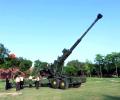
The ATAGS has a range of 35-45 kilometres, depending on the ammunition used, and achieved a 47-km firing range during trials.

China calls the shoal Huangyan Dao. China has already deployed some of its biggest CCG vessels in the area to assert its claims.

The role of the space sector in armed conflicts came into sharp focus during Operation Sindoor, which saw extensive use of drones and loitering munitions and tested the capabilities of air defence systems such as indigenously developed Akash Teer.

India's premier defence research organisation DRDO has awarded seven new projects to private entities to develop key military assets including underwater launched unmanned aerial vehicle and long-range remotely operated systems.

According to the DRDO chairman, the BrahMos missile, primarily launched from Sukhoi Mk 1, was used during the offensive phase.

India successfully test-fired the newly-developed tactical missile Pralay, capable of carrying conventional warheads, from APJ Abdul Kalam island off the coast of Odisha. The missile, developed by DRDO, has a range of 150 to 500 km and a payload capacity of 500-1,000 kg.
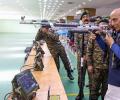
India has declared 2025 as the year of defence reforms, aiming to establish integrated theatre commands to enhance synergy among the three armed forces and transform the military into a technologically-advanced combat-ready force. The reforms will also focus on streamlining acquisition procedures, promoting collaboration, and leveraging emerging technologies like artificial intelligence and robotics.
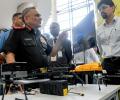
Chief of Defence Staff General Anil Chauhan emphasizes the importance of self-reliance in Unmanned Aerial Vehicles (UAVs) and Counter-Unmanned Aerial Systems (C-UAS) for India, citing recent global conflicts and Operation Sindoor as examples of their strategic importance.

Low-level lightweight radars; very short-range air defence systems (launchers and missiles); remotely piloted aerial vehicles; loitering munitions, including vertical take-off and landing systems; different kinds of drones; bullet-proof vests; ballistic helmets; quick-reaction fighting vehicles -- heavy and medium; and night sights for rifles (aiming devices that are visible in low light).
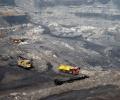
The government plans to establish a fully indigenous manufacturing ecosystem with an annual production capacity of up to 6,000 tonnes. The scheme is expected to run for seven years, according to official documents.
The Indian government outlines its futuristic defence programme, Sudarshan Chakra Mission, focusing on indigenous development, predictive technologies, and targeted counter-action systems to enhance national security.
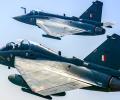
HAL aims to raise output from the current ceiling of 24 aircraft a year to 30 by the end of 2027
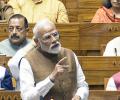
Prime Minister Narendra Modi defended India's actions against terrorism, stating no country stopped India and criticizing the Congress party for not supporting the armed forces. He highlighted the success of Operation Sindoor and warned Pakistan against further misadventures.

DRDO's failures over the decades have contributed significantly to India becoming the world's biggest weapons importer, points out Lieutenant General Prakash Katoch (retd).
